Research
Psychological development is characterized by profound change over time. What factors facilitate healthy psychological development, and what causes typical development to go awry? Once a mental health condition emerges, why do some people experience more severe illness trajectories than others? In the DIVERGE Lab, we use longitudinal, genetically informed research designs to understand how people differentiate over time as a function of their genetic background, environmental context, and individual experience.
Applying a developmental and lifespan perspective to psychiatric and behavioral genetics, our goal is to elucidate developmental factors that drive heterogeneity in behavioral change and differentiation over time. Ultimately, we hope to identify intervenable change mechanisms to facilitate healthy psychological development, reduce psychopathology risk, and facilitate discovery.
Our work is inherently transdisciplinary, sitting at the intersection of clinical, developmental, and quantitative psychology; psychiatric and behavioral genetics; and epidemiology. Methodologically, we emphasize longitudinal approaches, bridging family-based and molecular genetic designs.
Genomic and environmental influences on mental health trajectories
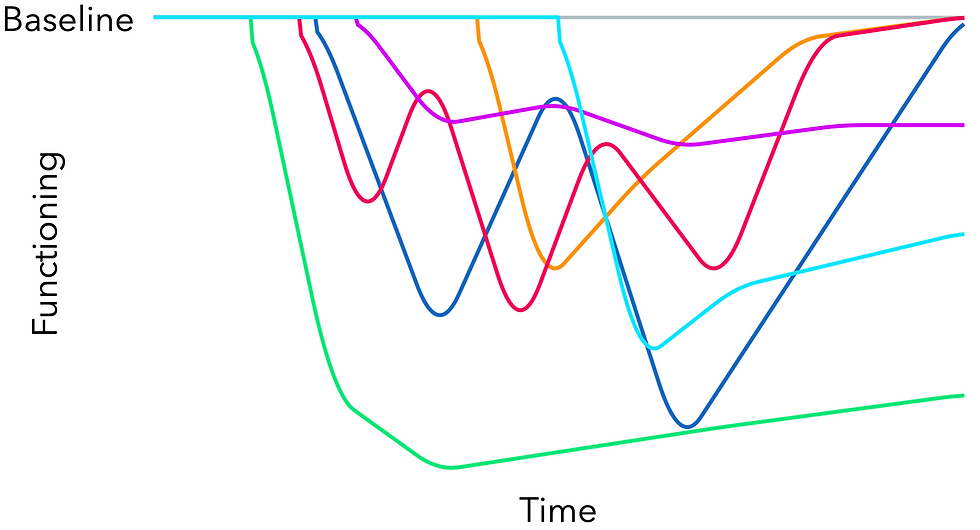
People with psychotic disorders experience heterogeneous courses of illness, varying in age of onset, severity, chronicity, and treatment response. However, little is known about why some people experience more severe psychotic disorder trajectories than others.
Leveraging large-scale, longitudinal clinical data (e.g., electronic health records), we examine how genomic differences and environmental exposures contribute to variation in the etiology, developmental course, and outcomes of schizophrenia, bipolar disorder, and other psychotic illnesses. We are particularly interested in integrating clinically relevant variables and social determinants of health into molecular genetic designs.


Longitudinal dynamics of gene-environment interplay across the lifespan
Psychological traits emerge from a complex interplay of genetic and environmental factors that unfolds across development. Our lab uses intensively assessed, longitudinal twin studies to examine how individuals grow and differentiate from each other behaviorally over time due to dynamic, reciprocal interactions between their genetics and their environments.
Analyzing cognitive development from infancy through midlife, we have demonstrated the cognitively beneficial influence of socioeconomic enrichment and, in contrast, the suppressive effects of environmental disadvantage. We are currently extending this work across the complete lifespan to cognitive aging and neurodegeneration.
Public Science
We are dedicated to addressing bioethical challenges facing psychiatric and behavioral genetics including the (mis)understanding and (mis)use of genetics research in scientific, clinical, and public contexts. Our lab conducts both empirical and theoretical research on public science issues in genetics, and spearheads international public science collaborations.
